Cosy Dens

Cosy Dens Film Difficulty Ranking: 2

If you’re looking for a comedy beyond the Iron Curtain, check out Cosy Dens. You’ll meet a mixture of Czech families celebrating Christmas in the 1960s – some Bolsheviks, some apolitical, some fans of America. As with any big family Christmas, there’s a lot of arguments. These ones often get hilariously out of hand.

From: Czech Republic, Europe
Watch: Trailer, Watch on Amazon
Next: Closely Watched Trains, The Royal Tenenbaums, Toni Erdmann
Continue reading “Cosy Dens – Dark Humour in Communist Czechoslovakia”
The Black Pin

The Black Pin Film Difficulty Ranking: 2

Why Watch The Black Pin?

  • If you like films set in quaint rural villages
  • To see how gentrification affects small rural towns around the world
  • For classic friendly dry humor
From: Montenegro, Europe
Watch: Trailer, IMDb
Next: Underground, The Flying Circus, Cosy Dens
Continue reading “The Black Pin – Gentrification in a Small Montenegrin Village”

Cries and Whispers Film Difficulty Ranking: 4

This is the ultimate malfunctioning family. One of the three sisters is dying, but the other two are preoccupied with their own lives. Watch this amazingly coloured film if you are looking for a brutal family drama. It’s not for the faint hearted!

Here’s three reasons to watch along with the film’s eerie soundtrack

Why Watch Cries and Whispers?
  • This is brutal family drama Shakespearean style
  • If you want to see a bit more from celebrated Swedish director Ingmar Bergman outside his big three (Seventh Seal, Persona, and Wild Strawberries)
  • For another exploration of life and death (this exploration is far more disturbing than Bergman’s Wild Strawberries)
  • To see some more beautiful colours (just as you just saw in Jude’s Scarred Hearts)
The Breakdown

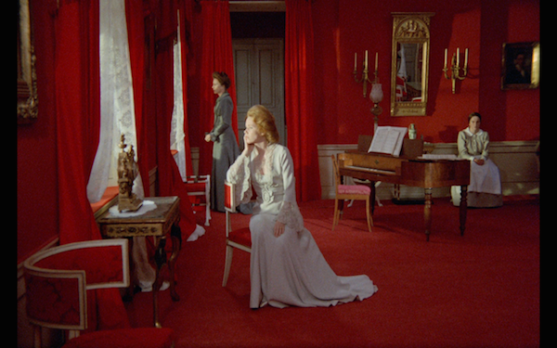
The film starts with the colour red. The only other thing we can perceive is the chimes of a small bell. Next, we see shots of statues and trees in what looks like a misty churchyard. After a few cuts, the misty churchyard fades into redness.

The red themes continue into the films beautiful red and white pictures (see below).

Image result for ingmar bergman cries and whispers
Vivid red and white palette used in Cries and Whispers

The colour grades are beautifully vivid, but why does Bergman use red and white? Well as put by Bergman below, the red represents the soul. You will notice that the red fades as the film progresses – along with the souls of the characters.

“Cries and Whispers is an exploration of the soul, and ever since childhood, I have imagined the soul to be a damp membrane in varying shades of red”

Another thing that fades as the film progresses is time. From the start you’ll hear the chimes of bells and clocks ticking. You’ll even see shots of clock faces that break up the film narrative. However, just like the fading of the vivid reds (that represent the soul), the images and sounds of time will fade. Agnes, and the other characters, are losing their time on earth.

Conclusion

Cries and Whispers is another dark Bergman film to satisfy your inner demons. It explores life and death and finds emptiness in one of the most vividly coloured sets I’ve seen. Watch this one after you’ve seen Wild Strawberries, Seventh Seal, and Persona to expand your film knowledge of the fantastic Ingmar Bergman.

The 10th Victim Film Difficulty Ranking: 2

Yes! There is a film which is a combination of Austin Powers and The Hunger Games. It’s called The 10th Victim and it was made in Italy in the 1960s. You may be thinking: “how does it work?” My answer is: don’t worry about it, the dystopian world that director Elio Petri creates is worth your time. It’s colours, setting, and subtle critiques of modern society make this film one of the most unique films and one that you should watch.

Why Watch The 10th Victim?
  • To watch the Italian 60s equivalent to the Hunger Games
  • This dystopia is complete with brothels, minimalist furniture and fashion, artificial insemination centres, and no old people!
  • It features Marcello Mastroianni from La Dolce Vita and Ursula Andress (the first Bond girl)
  • To find out more about ‘The Big Hunt’ – “Hitler would have become a member”
The Breakdown

The 10th Victim starts with a gun shootout between a man and a woman in an abandoned warehouse. As they are firing at each other, a narrator pauses the action to explain what is going on. The man and woman are members of ‘The Big Hunt’, a game where one plays 5 times as a hunter and 5 times as a victim. As a hunter, you are given a target to kill. However, as a victim, you must try and find out who your hunter is and kill them before they kill you. The one who comes out alive after 10 rounds is honoured and given $1million. Would you become a member?

The ‘Big Hunt theory’ is advertised throughout the film with it’s many slogans. Here’s some of the best:

  • “If you are suicidal, the big hunt has a special place for you”
  • “An Enemy a day keeps the doctor away”
  • “Hitler would have become a member”

The whole event was thought up as an outlet for violence (an idea also shown in The Most Dangerous Game based on the Spartan Crypteia event).

In The 10th Victim the violence is limited to those who choose to take part in the big hunt. Taking part is a quick way to find fame as the best killers are constantly stalked by paparazzi and dominate the news. These killers are the equivalent of today’s celebrity. They relish the spotlight, support the biggest brands, and always have to look good for the camera. This is one of the strangest, memorable critiques of capitalism on film.

Conclusion

Elio Petri’s The 10th Victim is a pop-culture blast. The world he creates is unlike anything you’ve seen, with bright colours, minimalistic architecture, and one-tone clothing. The wacky soundtrack confirms that Elio Petri’s tongue was firmly in his cheek when he was making this film. The cheesiness and laughs are all part of the satire that makes fun of consumerism, corporations, and celebrity culture. What a strange but awesome film!

Alexandra Film Difficulty Ranking: 3

Alexandra is a great film to watch for an insight into the Second Chechen War in southern Russia. This is probably a topic that you heard about in the news in the 2000s but didn’t know much about. Through our protagonist Alexandra, we are introduced to both sides fighting the war: the Chechens and the Russians. And, along the way, we also witness the reality of modern warfare, as well as a little bit about Russian family tyranny.

Why Watch Alexandra?
  • To find out something about the Second Chechen War in Chechnya
  • Experience life as a soldier
  • Learn about Chechen v. Russian culture (also two different languages)
  • It was nominated for a Cannes Palme D’Or
The Breakdown

Alexandra Nikolaevna hops off of a train on the way to visiting her son, fighting for Russia against the Chechen Republic. A few army officers come and find her and guide her to another train and then onto the top of an armoured vehicle. It isn’t clear what she is doing there, she is obviously out of place. Even the troops seem reluctant to talk to her and help her on her way.

She is ushered to sleep in a tent within the Russian army camp. The next morning she sees a man sleeping in a bed opposite hers. The director, Alexander Sokurov, guides us towards a close up of the man’s sleeping head which tracks down his body from head to toe. Alexandra and the audience both see his war battered body. The camera then focuses on an army jacket, showing the stars on the epaulettes showing his higher ranking. These two camera movements introduce Alexandra’s grandson Denis. From what we are shown, we can tell he is a soldier of a higher rank, and he is young, but already battered by what must be a prolonged war. (A great way of introducing a character without having to say anything).

After waking up, Denis takes his grandma for a tour around the army camp. Unlike other war films which focus on action, Alexandra (and Sokurov) direct our attention to the banalities of war. Sokurov shows us a line of men cleaning their guns, zooming in to show us the details. Denis then takes Alexandra into an armoured vehicle. Inside, Alexandra comments on the horrible smell and focuses on the wires, pumps, and empty drivers seat. In Alexandra, we see the guns and armoured vehicles but we don’t see them in action. This is the reality of war, prolonged periods of waiting.

Conclusion

Alexandra is our unbiased insight into the Second Chechen War. She gets everyone at the camp talking, from the lowly privates to the unit commander. Then, right when you think we are only going to hear from the Russian side of the story, she goes wandering into a nearby Chechen town and has a chat with an old Chechen woman. In a way that only an old woman could, she shows us life on the front line and gets soldiers to talk to us.

Also when you’ve watched this film, I’d recommend following this link to KinoKultura to read a more in-depth analysis of Alexandra.