Filipiñana

Filipiñana Film Difficulty Ranking: 3

If you’re looking for a film with land exploitation, the Filipino elite, and golf courses caught in the crosshairs of its sniper rifle, you’ve come to the right place. Filipiñana doesn’t shout. It silently stalks its prey in every carefully constructed frame, slowly revealing the insidious nature of the privatized paradises that are quietly conquering a country and its people. It’s a remarkable debut film from Rafael Manuel, who marks himself as a powerful one to watch.

From: Philippines, Asia
Watch: JustWatch, IMDb
Next: A Touch of Sin, Ascension, The French Dispatch

Filipiñana – The Breakdown

If you’ve seen Manila on screen or been in person, you’ll find nothing unfamiliar in the opening of Filipiñana. The first shot of a bus driver navigating busy streets tinted with warm colors evokes the heat and vibrant life of the city. The friendly tourist leader’s voice speaking to a silent crowd of Chinese tourists also highlights one of the country’s biggest industry’s: tourism. However, the familiarity of the opening is set against the political nature of the next two shots.

  1. A shot of Filipinos lining up for clean drinking water.
  2. A shot of a lush green golf course being showered by a cascade of water.

This juxtaposition is the jumping point into the privatized, fabricated paradises of the Filipino golf courses; luxuries reserved for the elite and served by the working class. This carefully constructed, slightly zany film, is a criticism of the globalized capitalist land-complex that swallows up indigenous land and crafts it into exclusive resorts.

The director, Rafael Manuel, follows two female protagonists from different social standings in this film. Isabel is a worker that has recently arrived from the Ilocos region in the north-west. It’s a region where palm trees and lush environments are expected; a landscape that the elite have artificially recreated in golf courses. As a new hire, Isabel is still learning the subservience her job demands, and Manuel doesn’t shy away from showing it. In one shot, she is sexualized by being framed between a golfer’s legs, carefully placing his golf balls on the tee in close proximity to the danger of his swing. It highlights how exposed she and her colleagues are to danger and sexual exploitation. While Isabel is initially drawn to the president through a sense of shared heritage (the president in Filipiñana is a close copy of real President BongBong Marcos, who is also from Ilocos), her journey is one of growing awareness from ignorance to recognition of her own exploitation.

In contrast, Clarita, a niece of a golf company CEO, is simply visiting family in the Philippines from her base in New York. She’s initially aware of the class differences between her life in the U.S. and those living in the Philippines, but that awareness gets stifled by the status quo as she settles into the fake hospitality afforded to her as a privileged guest. While the uncanny valley nature of the luxurious golf course awakens something in Isabel, it dulls Clarita’s mind instead, welcoming her into the comfort of the Filipino elite.

Isabel and Clarita’s respective journeys to enlightenment and dulled awareness are guided by an invisible protagonist: the heat. The sun’s rays paralyze the characters throughout the film. It’s a constant presence, since the entire film is shot in piercing daylight. The heat influences everything in the film, from the slow languid camera pans and long, patient shots, to the slow-moving characters and the sparse, unhurried dialogue. The stifling heat also becomes a visual metaphor for the characters’ inaction; their unwillingness to challenge either their own exploitation or the status quo. Interestingly, the only character that appears to be immune to the inhibiting effect of the heat is the golfing, singing, dancing President. It’s as if he’s an inverse vampire that thrives in the daylight and still manages to suck the life out of everyone else. Seen in this light, it’s a neat criticism of a President that has consistently expanded the ability of foreign investors to control Filipino land.

Conclusion

Filipiñana operates with measured power, firing subtle shots at the Filipino elite who built the exploitative, global-capitalist land complex, and at the people who go along with it. Every frame in this film is as carefully constructed as a Wes Anderson film to support this. In Filipiñana, Rafael Manuel lights his career with a bang, marking himself as a major talent to keep track of in the future.

Image result for roma cuaron

Roma Film Difficulty Ranking: 3

If you love great film or want to be guided around 1970s Mexico City, you’ve come to the right place. Roma is one of the best films you’ll see this century. It’s stream of consciousness narrative feels like life and memory, and the acting and cinematography is a visual treat. Open you’re mind and immerse yourself in Roma.

From: Mexico, North America
Watch: Trailer, Netflix
Next: 8½, Boyhood, Ixcanul
Continue reading “Roma – Mexico City Bathed in Black & White Beauty”
Image for i am cuba

I Am Cuba Film Difficulty Ranking: 3

Soviet-made Cuban films don’t do half measures, they go all in. I am Cuba is no exception. The cinematography is more stylish than most films you’ll ever see and some of the shots are truly unforgettable. Add in Cuban history from the 1920s to the 1950s and you’ve got one truly epic film.

From: Cuba, North America
Watch: Trailer, Watch on Amazon
Next: Lucia, Battle of Algiers, Battleship Potemkin
Continue reading “I am Cuba – A Soviet Made Masterpiece”
Call Me by Your Name Film Difficulty Ranking: 3

If you’ve ever dreamed of falling in love under the Italian sun, this film may just take you to dreamland. Call Me by Your Name has all the ingredients for a perfect romantic film. It’s got sun, fresh food, beautiful people, lakes and rivers, and freedom. All you’ll need is a glass of wine.

Why Watch Call Me by Your Name?
  • If you like sensual romance (also see Guadagnino’s I Am Love)
  • To escape to the beautiful Italian summer
  • It’s been nominated for Best Picture at the Oscars
  • If you like coming-of-age stories
The Breakdown

Call Me by Your Name starts with 17 year old Elio. He’s chilling in his parents house in Northern Italy with his girlfriend Marzia for his summer holidays. A few seconds later, Oliver arrives, a grad student from Elio’s dad’s university class in America. He’s come to Europe for the summer to help Elio’s dad with his research and lap up the Italian sun.

The Italy we see in Call Me by Your Name is the Italy we dream of. The sun is forever shining and the warm colours almost give off the heat. As this is set in the 1980s, before Internet, there are no phones or computers as we know today, and these guys don’t watch TV. Instead, they swim, play volleyball, lounge in the sun, eat Al-fresco, and read. It’s pretty much the ideal summer holiday – everyone is happy and relaxed. Plus, the beautiful environment heightens the beauty of everyone within it.

It’s also no surprise that Elio and Oliver are attracted to each other. Everything you see in their environment symbolizes the ripeness of their relationship. There are trees laden with ripe fruit, flies buzzing on and off the screen (you can always hear them), and fresh water. In addition, there’s the constant sun. The environment is a metaphor for their growing love for each other, identifying it before they do.

Whilst the sensual environment reveals their growing love to the audience, Elio and Oliver are still unaware of each other’s feelings. Instead, they performing an intellectual mating ritual in which they both try to show-off their proficiency in high art to the other. Firstly, Oliver manages to prove his intelligence by correcting Elio’s dad on the origins of the word ‘apricot.’ Secondly Elio gets his chance to show-off when he plays the guitar and piano. The ‘mating ritual’ finally ends when Oliver admits defeat and asks Elio if there is anything he doesn’t know which gives Elio the confidence to subtly declare his love.

Image result for call me by your name

Conclusion

If you’ve seen any of Guadagnino’s other films, you’ll know that he’s a master of sensuality. In Call Me by Your Name he doesn’t disappoint. It’s the perfect coming-of-age story of Elio’s first love. You’ll almost forget it’s a gay romance (if Oliver doesn’t keep repeating ‘let’s be good’) as this film is first and foremost a beautiful romance.

Film Buff Ranking: 1

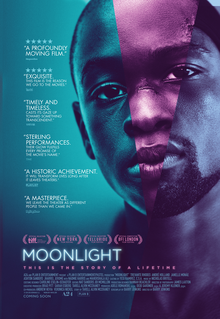
Moonlight (2016 film).pngIs Moonlight a future Oscar winner? It is everything an Oscar winner should be: beautifully shot, emotional, powerful. Furthermore it is also what the Oscars have lacked: a great non-biographical black film. This film reminded me of the early chapters of Ta-Nehisi Coate’s Between the World and Me or Kendrick Lamar’s Good Kid, M.A.A.D City because it shows the influence of environment on people. We are not always what we portray on the outside.

Why Watch Moonlight?
  • Change the way you think about people – did you know that the script writer was taught how to ride a bike by a drug dealer who saw him struggling to learn?
  • For beautiful Miami cinematography – sweat glistening in the moonlight
  • Could this be an Academy Award winner?
  • Is sexuality the biggest taboo in Western society?
The Breakdown

The first things we hear are Boris Gardiner’s ‘Every N****r Is a Star’ playing on a car radio. The driver, Juan, parks his car and walks over to another guy standing on the side of the road. They chat small talk to each other – the drug selling is all good. As Juan walks back to his car a kid runs past him, chased by a group of kids. The kid runs into an abandoned house and hides as the others throw stones through the window. Later, Juan tears down one of the window boards where the young kid is hiding and takes him under his wing.

Split into three chapters portraying another stage of Chiron’s life, Moonlight tracks Chiron’s progression. In each, he is almost unrecognisable physically, as he transforms from little kid to lanky teenager to muscly man. However, his eyes never change – he is always the shy kid found by Juan in chapter one.

In the final chapter you can see that Chiron has tried to bury the person he is. This is emphasised in the music he plays in his car. His music is ‘chopped and screwed’ – aka it is slowed down, scratched up, and cut up. You often can’t recognise music which has been ‘chopped and screwed’. Similarly you can’t recognise Chiron. He has been ‘chopped and screwed’ like the music. The person he was has been distorted so much that we no longer recognise him.

Conclusion

Moonlight is not just a ‘black film’, Moonlight is a universal film that sheds a light on everyone who cannot be who they are. It applies to those who try to repress their sexuality, those who try to fit in by being someone they are not, and those who cannot be who they want. Most people have compromised their self to fit in at some point (at school or beyond).

In a similar way, this film never tries to be something pretentious or important. It has no idols or figures to be revered like the fiction or non-fictional films featured at the Academy Awards before. This is a real story in a sea of films filled with their own self-importance. Go and watch it!

My Sources - The Director, Screenwriter, and Cast
My Sources – The Director, Screenwriter, and Cast