Call Me by Your Name Film Difficulty Ranking: 3

If you’ve ever dreamed of falling in love under the Italian sun, this film may just take you to dreamland. Call Me by Your Name has all the ingredients for a perfect romantic film. It’s got sun, fresh food, beautiful people, lakes and rivers, and freedom. All you’ll need is a glass of wine.

Why Watch Call Me by Your Name?
  • If you like sensual romance (also see Guadagnino’s I Am Love)
  • To escape to the beautiful Italian summer
  • It’s been nominated for Best Picture at the Oscars
  • If you like coming-of-age stories
The Breakdown

Call Me by Your Name starts with 17 year old Elio. He’s chilling in his parents house in Northern Italy with his girlfriend Marzia for his summer holidays. A few seconds later, Oliver arrives, a grad student from Elio’s dad’s university class in America. He’s come to Europe for the summer to help Elio’s dad with his research and lap up the Italian sun.

The Italy we see in Call Me by Your Name is the Italy we dream of. The sun is forever shining and the warm colours almost give off the heat. As this is set in the 1980s, before Internet, there are no phones or computers as we know today, and these guys don’t watch TV. Instead, they swim, play volleyball, lounge in the sun, eat Al-fresco, and read. It’s pretty much the ideal summer holiday – everyone is happy and relaxed. Plus, the beautiful environment heightens the beauty of everyone within it.

It’s also no surprise that Elio and Oliver are attracted to each other. Everything you see in their environment symbolizes the ripeness of their relationship. There are trees laden with ripe fruit, flies buzzing on and off the screen (you can always hear them), and fresh water. In addition, there’s the constant sun. The environment is a metaphor for their growing love for each other, identifying it before they do.

Whilst the sensual environment reveals their growing love to the audience, Elio and Oliver are still unaware of each other’s feelings. Instead, they performing an intellectual mating ritual in which they both try to show-off their proficiency in high art to the other. Firstly, Oliver manages to prove his intelligence by correcting Elio’s dad on the origins of the word ‘apricot.’ Secondly Elio gets his chance to show-off when he plays the guitar and piano. The ‘mating ritual’ finally ends when Oliver admits defeat and asks Elio if there is anything he doesn’t know which gives Elio the confidence to subtly declare his love.

Image result for call me by your name

Conclusion

If you’ve seen any of Guadagnino’s other films, you’ll know that he’s a master of sensuality. In Call Me by Your Name he doesn’t disappoint. It’s the perfect coming-of-age story of Elio’s first love. You’ll almost forget it’s a gay romance (if Oliver doesn’t keep repeating ‘let’s be good’) as this film is first and foremost a beautiful romance.

Loveless Film Difficulty Ranking: 3

If you’ve seen Zvyagintsev’s Leviathan you need to see Loveless. If you haven’t seen Leviathan, what are you waiting for? Loveless is another dark drama from Zvyagintsev of epic proportions. It’s comparable to one of Shakespeare’s dark plays updated for the digital age. Plus, it’s not just a reflection of Russian society, but a reflection of all our lives.

Why Watch Loveless?
  • You can’t find better drama than this
  • It’s a story you usually don’t see on screen – what happens after the happy marriage – and yes, it’s dark
  • It’s the follow up to Zvyagintsev’s award winning Leviathan and it’s already won the Cannes Jury prize, you don’t have to rely on our opinion!
  • The setting! The snow and empty spaces make it even more chilling!
The Breakdown

Loveless starts with snow. It makes the town it falls on seem more serene; the calm before the storm. It’s the end of school for the day and the camera follows 12 year old Alexey as he walks home on his own. He finds a strip of police ‘do not cross’ tape and waves drags it along with him through the snow before throwing it into a leafless tree. Unlike his parents, he’s just a regular kid.

The opening 5 minutes of the film are focused on Alexey, but then the film is hi-jacked by his parents. When Alexey returns home, we find his parents arguing (they’re getting divorced). From their argument, we follow them through a day of each of their lives at work and their affairs for the next 30 minutes of the film. Alexey’s parents are doubly selfish. They steal the film’s narrative from him and also indulge in their own self-interests whilst they have the limelight. They force Alexey out of the film.

You may also notice the abundance of empty spaces and silence in the movie. The director may linger on a shot after the character has left or remain fixed on a character for slightly longer than normal. Zvyagintsev left these visual and audible pauses for us to give us time to think. This allows us to become ‘co-authors’ as we have time to add in our own interpretations. You’ll see that whilst Loveless is a Russian film, the message is relevant to all of us – making it possible to interpret.

Image result for loveless film

Conclusion

Loveless was one of the stand out films for me at the London Film Festival 2017. Just like Leviathan (which you should watch if you haven’t already) it’s storytelling is at the top level. On top of that, the visuals are a perfect compliment – they make the dark bits of the story darker, and offer us breaks to become co-authors.

Watch it when you can!


Nobody Knows

Nobody Knows Film Difficulty Ranking: 3

Nobody Knows is one of the most moving and heart breaking films I’ve seen. You’ll meet some children treated as baggage (very literally in the opening scene) by their irresponsible mother. They’re left at home alone to fend for themselves for long periods forcing them to learn and do everything themselves. In this film, the adults are childish and the kids are forced to become adults to survive.

From: Japan, Asia
Watch: Trailer, JustWatch
Next: Shoplifters, Grave of the Fireflies, The Florida Project
Continue reading “Nobody Knows – Children Forced to Become Adults”

Man With A Movie Camera Film Difficulty Ranking: 3

Man With A Movie Camera is one of the most influential films from the silent era. Made in 1929 by Dziga Vertov, it uses a range of effects that have been copied throughout the existence of cinema. It was one of the first to employ rapid cutting, split screens, slow motion, and dissolves. It also threw in a load of magic through messing with perspective, using stop motion, and literally having magicians on screen. All the effects come together to create a work imbued with excitement for the potential of modernity to change Russia and the world. This film feels like a celebration of life bottled up in a time capsule from 1920’s urban Russia.

From: Russia, Europe
Watch: Kanopy, YouTube, JustWatch
Next: Battleship Potemkin, I Am Cuba, Metropolis

Extraordinary Stories Film Difficulty Ranking: 3

This is storytelling at it’s finest. If you’re a fan of Borges or Pynchon’s mysteries you’ll love this film. Save this 4 hour wonder for a long journey or break it up into three viewings (with the 2 intervals). You can even try watching it here on YouTube.

Image result for extraordinary stories film

Why Watch Extraordinary Stories?
  • To see another great Argentinian film which is up there with Wild Tales and Secret in their Eyes (not the Hollywood remake)
  • Witness storytelling at it’s finest!
  • If you want 4 hours to go quickly (perfect for a long journey), otherwise this film is broken into three parts so easy to break into multiple viewings
  • Perfect for fans of Borges or Pynchon!
The Breakdown

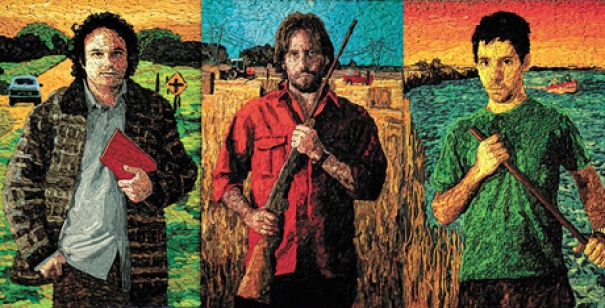
Extraordinary Stories starts with the story of X, a man walking down a road. He is walking to a nearby town, not really sure if he will find a job there. Whilst he is walking down the road, he witnesses a shootout in a farm field next to the road. Have the perpetrators seen him watching?

This opening episode makes up episode 1. Next up is the story of Z, a man who has just started a new job in a remote town. The third story centres a bet between two rivals.

Without giving anything more away, each of the three stories get more and more interesting and extraordinary as the film progresses. Each one progresses in 5-15 minute episodes and you are often left wanting to see more at the end, like a good TV series.

The strangest part is that you never really find out much about the three main protagonists (X, Z, and H). You never learn their name or their background; each of them remains a mystery. They reminded me of characters from a Borges short story or a Pynchon novel.

Conclusion

You won’t find storytelling better than this. I was skeptical about this 4 hour movie, but I couldn’t stop watching it after I hit play. The director gives you enough to pique your interest in each short episode, always leaving you wanting to watch more.