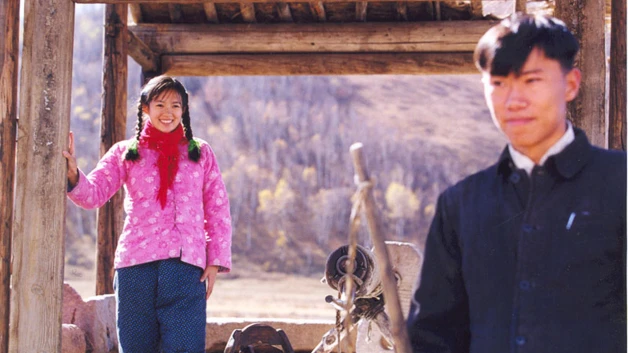
The Road Home Film Difficulty Ranking: 2

Are you looking for a love story that will warm your heart? Or are you looking to explore rural China and all it’s customs and culture? Either way, check out The Road Home, a beautiful love story set in rural China directed by Zhang Yimou. Currently available to watch here on Amazon (for rent)

Why Watch The Road Home?
  • If you’re in the mood for a romantic love story
  • You’re a fan of Zhang Yimou’s martial arts films (Hero, House of Flying Daggers) and you want to see him explore something different
  • To learn about customs (and superstitions) in rural China
  • See how different school is in this film
The Breakdown

The first part of The Road Home is shot in the present day in dull black and white. Luo Yusheng arrives at his family home in rural China having traveled from his home in the city. His father has just died, and he’s come home to keep his mum company and sort out the funeral arrangements.

Tradition says you need to carry the dead all the way home whilst shouting out ‘this is the way home’ to remind them how to return. Yusheng’s mum is adamant that he must honor this tradition for their father. However, this tradition has rarely been carried out since the Cultural Revolution in the 60s and 70s. Whilst he’s figuring out what to do with his father’s body, the narrative switches to the story of Lusheng’s parents romantic courtship which has become a legend in their hometown.

Is this film a challenge to the state of Communism in China?

On the surface, The Road Home appears to be a regular love story. But, if you pay a bit more attention, you’ll see an underlying critique of the state of Communism in China.

In The Road Home, Zhang Yimou critiques the loss of culture. You’ll hear this first when the mayor says that the traditional burial mentioned above has not been done since the Cultural Revolution (a subtle jab against the Cultural Revolution for taking away part of Chinese Culture). But, more obviously the critique is present in the film’s portrayal of the past.

Whilst the present is shot in a dull black and white, the past is shot in vibrant colour. The colour reflects the emotion and hope embedded in the past, when the Communist Revolution was still young. In contrast the dull black and white of the present symbolises how the hope and optimism of the Communist Revolution has disintegrated and has taken culture and emotion with it.

Image result for the road home film

Conclusion & What To Watch Next

The Road Home is a beautiful love story set in rural China. Luckily for all of you who don’t want to settle for pure cheesy romance, there’s much more to this film than initially meets the eye. Because if you look carefully, you’ll see the subtle critique of the direction of Chinese Communism.

If you want more romance, click here to explore all the films under in our Love film category.

Or if you’re looking for more Chinese film, head over to our Chinese film page. We recommend checking out A Touch of Sin for a more brutal depiction of life in contemporary China.


Vai

Vai Film Difficulty Ranking: 2

Why Watch Vai?

  • For a collection of 8 short films set across the Pacific Islands
  • See a shared indigenous Pacific Islander experience
  • It’s a powerful feminist tribute, featuring 8 women, and directed by 9
From: Cook Islands, Fiji, New Zealand, Niue, Samoa, Solomon Islands, Tonga, Australasia
Watch: Trailer, Amazon Prime, Tubi, JustWatch
Next: Whale Rider, Boyhood, The Orator

a collection of short films

Vai is a collection of eight short films made by 9 women which takes place across seven different countries (Fiji, Tonga, Solomon Islands, New Zealand, Kuki Airani, Samoa, and Niue). The titular character, Vai, is played by eight different indigenous women aging from 6 to 80.

Another interesting thing to note before watching is that ‘Vai’ translates as ‘water’ in each of the countries named above. Water is an integral part of the story. It surrounds each of the islands, which isolates each community, making traveling between islands harder. It’s ability to provide food is threatened as companies infringe on and overfish in traditional fishing waters. Drinking water is also rare and hoarded by the privileged. Most importantly, it gives life, both spiritually (as in the final short) and physically.

“We sweat and cry salt water, so we know that the ocean is really in our blood”

Teresia Teaiwa

A Common Indigenous Experience

Vai’s journey is played by 8 different indigenous actresses across 7 different countries and 8 different ages. In the first short, Vai is a 6 year old girl in Fiji, and the film progresses until the final short shows her as an 80 year old woman in Aeotara (New Zealand). By shooting Vai’s journey with different actresses across different countries, Vai creates a common indigenous Pacific Islander experience.

One common theme is the cycle of leaving and returning. In the first three shorts, Vai lives without her mother or father, as they’ve been forced to travel to New Zealand to try and provide for their family. In the fourth, Vai has already left Samoa and is studying in New Zealand. The final four films feature an older Vai that has returned to home. She returns and has to relearn the traditional ways she has forgotten. Whilst she regains her community, her younger relatives leave their homes just as she did, repeating the cycle of coming and going.

(Insert analogy comparing the coming and going of the people and tradition to the coming and going of the sea tides).

A Life Well Lived

The Pacific Islander experience may be new to some viewers, however, the experience of life is much more universal. It’s scope reminded me a little bit of Linklater’s Boyhood, except here the scope is much larger. Instead of focusing on a child from 8 years old to 18, Vai follows a woman across a whole lifetime. In doing so it encapsulates the entire experience of life in 90 minutes. When you’re watching Vai as an 80 year old, the memories of the shorts of Vai as a 6 and 13 year old are still clear in your head which allows us to enter Vai’s old age with a greater understanding of where she came from. These are memories that we often lose touch of once we hit adulthood in our own lives. Showing it all in one film lets us see life repeating itself and allows us to better empathize with Vai as an older woman.

What to Watch Next

If you’re after more indigenous stories from the Pacific Islands, check out Whale Rider, The Orator, Waru, or even Tanna. For too crossover films you could also check out Hunt for the Wilderpeople and Rabbit Proof Fence.

Or, if you’re looking for more films which follow a single character across different ages, I’d strongly recommend checking out Boyhood and Moonlight. They’re two great U.S. films about growing up.

Ilo Ilo

Ilo Ilo Film Difficulty Ranking: 2

Follow a 28 year old Filipino maid as she starts work for a dysfunctional family in Singapore. They all have their problems and bad habits, but they’re all human, just like us. Ilo Ilo perfectly captures the up and down emotions of everyday life in this family’s home and the immigrant experience in Singapore.

From: Singapore, Asia
Watch: Trailer, Tubi, Kanopy, Rent on Amazon, Buy on Amazon
Next: Roma, Scent of Green Papaya, Shoplifters
Continue reading “Ilo Ilo – Help Out A Dysfuntional Family in Singapore”
Crime of Father Amaro Film Difficulty Ranking: 2

If you love controversy with plenty of drama, check out The Crime of Father Amaro. It’s a full frontal attack on the Catholic Church in Mexico which many tried to ban. Whilst it’s not as damaging as Spotlight, it will remind you that all of us are human no matter what position we’re in.

Here’s a dramatic trailer for a dramatic film.

Why Watch Crime of Father Amaro?
  • It’s controversial – religious groups lobbied to ban it in Mexico but their attempts backfired as the publicity rocketed this film to success at the box office
  • To see Gabriel Garcia Bernal (famous for Y Tu Mama Tambien, No, Motorcycle Diaries and many more)
  • If you love a bit of melodrama
  • It was Oscar nominated for best foreign language picture
The Breakdown

The opening of the film deliberately leads us to sympathize with the young Father Amaro (Garcia Bernal). Firstly, he’s charitable. When the elderly man he sits next to on the bus is robbed, he reimburses him with his own money. Secondly, he appears friendly. The local kids run around him after he playfully grabs their football and he chills with the fellow pastors to watch football on TV. He has all the makings of a great guy. However, the melodrama slowly kicks to life as he begins to take advantage of one of the parish girls who is clearly infatuated with him.

There are plenty of omens that something is going to go wrong. Firstly,  you’ll notice that wherever Father Amaro is, the statues of the Saints and Jesus are always watching him. There’s a statue of Jesus that watches over him at home, from his bedside table. Furthermore, the director makes sure you notice each of the saints looking down at him whenever he is in the church by cutting to static shots of each one as he walks down the aisle. Nothing he does escapes from their view.

Secondly, the saints have a helper in a crazy old woman aptly named Dionisia after the Greek God Dionysus, the God of Wine, as well as ritual madness and religious ecstasy. It’s clear that Dionisia is both mad and madly religious. In addition, she also comparable to the witches from Shakespeare’s Macbeth. She predicts the love affair between Father Amaro and Amelia.

The two omens (the Saints and Dionisia) are both critiques of Catholicism. Firstly, of all the sins that are committed in plain sight of the saints and then confessed the next day. And secondly, of how it is interpreted by the population (Dionisia has malformed dolls posing as Saints, and tries to exorcise her disabled neighbor).

Image result for crime of father amaro

Conclusion

The Crime of Father Amaro is another great controversial melodrama from Mexico. It attacks the Catholic Church it’s hypocrisies, so it’s not surprising that Catholic groups tried to ban it. Unfortunately for them, the controversy propelled it to become the biggest film in Mexico.

If you want even more religious controversy, check out Oscar winner Spotlight. However, if you want blatant provocation, check out the Mexican film Battle in Heaven. If you want to see some more great Mexican film, check out our Top Ten Mexican Films here.


The Fourth Man

The Fourth Man Film Difficulty Ranking: 2

“I lie the truth, until I no longer know whether something did or did not happen.” Who can you trust in this psycho-thriller from Verhoeven.

From: Netherlands, Europe
Watch: Trailer, Buy on Amazon
Next: Oldboy, Who Killed Teddy Bear?, The Shining
Continue reading “The Fourth Man – Dutch Thriller Full of Symbolism”