Alexandra Film Difficulty Ranking: 3

Alexandra is a great film to watch for an insight into the Second Chechen War in southern Russia. This is probably a topic that you heard about in the news in the 2000s but didn’t know much about. Through our protagonist Alexandra, we are introduced to both sides fighting the war: the Chechens and the Russians. And, along the way, we also witness the reality of modern warfare, as well as a little bit about Russian family tyranny.

Why Watch Alexandra?
  • To find out something about the Second Chechen War in Chechnya
  • Experience life as a soldier
  • Learn about Chechen v. Russian culture (also two different languages)
  • It was nominated for a Cannes Palme D’Or
The Breakdown

Alexandra Nikolaevna hops off of a train on the way to visiting her son, fighting for Russia against the Chechen Republic. A few army officers come and find her and guide her to another train and then onto the top of an armoured vehicle. It isn’t clear what she is doing there, she is obviously out of place. Even the troops seem reluctant to talk to her and help her on her way.

She is ushered to sleep in a tent within the Russian army camp. The next morning she sees a man sleeping in a bed opposite hers. The director, Alexander Sokurov, guides us towards a close up of the man’s sleeping head which tracks down his body from head to toe. Alexandra and the audience both see his war battered body. The camera then focuses on an army jacket, showing the stars on the epaulettes showing his higher ranking. These two camera movements introduce Alexandra’s grandson Denis. From what we are shown, we can tell he is a soldier of a higher rank, and he is young, but already battered by what must be a prolonged war. (A great way of introducing a character without having to say anything).

After waking up, Denis takes his grandma for a tour around the army camp. Unlike other war films which focus on action, Alexandra (and Sokurov) direct our attention to the banalities of war. Sokurov shows us a line of men cleaning their guns, zooming in to show us the details. Denis then takes Alexandra into an armoured vehicle. Inside, Alexandra comments on the horrible smell and focuses on the wires, pumps, and empty drivers seat. In Alexandra, we see the guns and armoured vehicles but we don’t see them in action. This is the reality of war, prolonged periods of waiting.

Conclusion

Alexandra is our unbiased insight into the Second Chechen War. She gets everyone at the camp talking, from the lowly privates to the unit commander. Then, right when you think we are only going to hear from the Russian side of the story, she goes wandering into a nearby Chechen town and has a chat with an old Chechen woman. In a way that only an old woman could, she shows us life on the front line and gets soldiers to talk to us.

Also when you’ve watched this film, I’d recommend following this link to KinoKultura to read a more in-depth analysis of Alexandra.
Cries and Whispers Film Difficulty Ranking: 4

This is the ultimate malfunctioning family. One of the three sisters is dying, but the other two are preoccupied with their own lives. Watch this amazingly coloured film if you are looking for a brutal family drama. It’s not for the faint hearted!

Here’s three reasons to watch along with the film’s eerie soundtrack

Why Watch Cries and Whispers?
  • This is brutal family drama Shakespearean style
  • If you want to see a bit more from celebrated Swedish director Ingmar Bergman outside his big three (Seventh Seal, Persona, and Wild Strawberries)
  • For another exploration of life and death (this exploration is far more disturbing than Bergman’s Wild Strawberries)
  • To see some more beautiful colours (just as you just saw in Jude’s Scarred Hearts)
The Breakdown

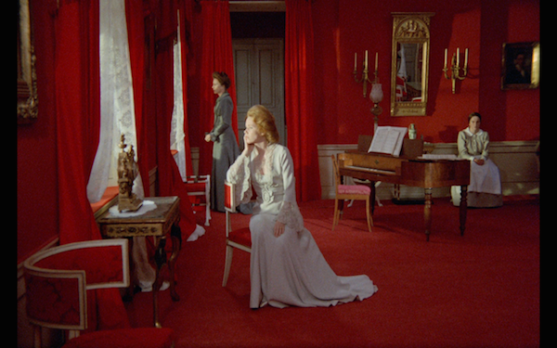
The film starts with the colour red. The only other thing we can perceive is the chimes of a small bell. Next, we see shots of statues and trees in what looks like a misty churchyard. After a few cuts, the misty churchyard fades into redness.

The red themes continue into the films beautiful red and white pictures (see below).

Image result for ingmar bergman cries and whispers
Vivid red and white palette used in Cries and Whispers

The colour grades are beautifully vivid, but why does Bergman use red and white? Well as put by Bergman below, the red represents the soul. You will notice that the red fades as the film progresses – along with the souls of the characters.

“Cries and Whispers is an exploration of the soul, and ever since childhood, I have imagined the soul to be a damp membrane in varying shades of red”

Another thing that fades as the film progresses is time. From the start you’ll hear the chimes of bells and clocks ticking. You’ll even see shots of clock faces that break up the film narrative. However, just like the fading of the vivid reds (that represent the soul), the images and sounds of time will fade. Agnes, and the other characters, are losing their time on earth.

Conclusion

Cries and Whispers is another dark Bergman film to satisfy your inner demons. It explores life and death and finds emptiness in one of the most vividly coloured sets I’ve seen. Watch this one after you’ve seen Wild Strawberries, Seventh Seal, and Persona to expand your film knowledge of the fantastic Ingmar Bergman.

After the Rehearsal Film Difficulty Ranking: 4

Bergman is back on FilmRoot to play with your mind. What initially seems like an ordinary conversation between two characters becomes something that you start doubting. See if you can gauge whether the characters are acting or just having a regular conversation. Top marks to anyone that can decipher it!

Image result for after the rehearsal

Why Watch After the Rehearsal?
  • For more Ingmar Bergman! We’ve already looked at Persona and Cries and Whispers so here’s more from the Swedish maestro!
  • If you love the theatre – this one has plenty of Strindberg references and even looks like a play
  • You love character focused dramas
  • It’s another film that messes with you (like in Persona and Mulholland Drive)
The Breakdown

After the Rehearsal starts with a shot of the floor which works its way across a carpet, up to a desk to show a man’s head lying on the desk. He is lingering on the stage set after the rehearsal to reflect. His narrative voice kicks in with an inner monologue reminiscent of Bergman’s opening to Wild Strawberries.

The man’s inner monologue is interrupted by an actress returning to the set to collect something she left behind. The man wants to carry on thinking, and whilst he politely greets the actress with his voice, his inner voice shouts at her to go away.

Unfortunately for him (and for the sake of entertainment) the young actress does not go away and they start talking. They talk about life and the future and other things. However, the manner they both show emotions and talk to each other becomes more and more unclear to us. Are the acting? Is the actress a figment of the man’s imagination? Or are they just chatting?

Conclusion

Bergman always likes to play with his audience (most notably in Persona) and he does it again here. In this film, he blurs the lines between life and acting. He even hints that the actress could just be a figment of the man’s imagination. What a trickster! This one is another classic Bergman to play with your head!

I recommend checking out the ‘Breaking Down Bergman’ YouTube channel after you’ve seen this film to find out more. Link here.

Beyond the Clouds Film Difficulty Ranking: 2

Are you looking for a big film for a bit of entertainment? With music, melodrama, and some epic shots? Look no further than Majid Majidi’s Beyond the Clouds. This Iranian director is one of the best at making great family films (check out Children of Heaven). Plus, if you liked Slumdog Millionaire (another great Mumbai film made by a foreigner) you’ll love this. It’s pure entertainment.

Image result for beyond the clouds

Why Watch Beyond the Clouds?
  • To be entertained! There’s big sweeping shots and beautiful colours! You’ll notice the echoes of Slumdog Millionaire
  • For the music composed by A R Rahman (it’s not a musical, but you’ll notice the Bollywood touch)
  • To learn to appreciate the NHS (and all other countries with public healthcare)
  •  See the melting pot of Indian diversity – in this film you’ll hear Hindi, Tamil, and bits of English
The Breakdown

Beyond the Clouds opens with a wide shot of a highway bridge in Mumbai. The camera tracks downwards to show us life under the highway. As Majid Majidi (the director) states, he wanted to get under the skin of the city, and right from the start he focuses on life that has escaped modernisation.

There’s a lot going on in each shot. We meet our protagonist walk-dancing along an empty path with his friend. They both hop on the back of a motorbike and zoom off down an empty straight road like cowboys riding towards the sunset. The sweeping camera movements and dance steps make it feel like you’re watching a big film. This is pure entertainment.

You’ll also be led by Majidi’s use of colours and darkness. When Amir visits his sister, she recounts all her traumas from the shadowed darkness of her bedroom. She has been ignored, emphasised by the darkness she is left in. Likewise the white sheets left to dry outside the busy clothes washers are a perfect symbol of innocence. Innocence that is fated to be stained…

Conclusion

This is why you go to watch films on the big screen. It has the wide sweeping shots, vivid colours, music, and plenty of melodrama. Yes, there’s a little cheesiness, but not enough to put you off. If you want to be entertained for a few hours, you can’t much go wrong watching Beyond the Clouds.

The Eagle Huntress Film Difficulty Ranking: 2

For beautiful scenery, eagles, and sexism check out The Eagle Huntress. It’s the closest you’ll get to a real life version of How to Train Your Dragon. Plus you can watch it here on Amazon (free with Prime).

Image result for eagle huntress

Why Watch The Eagle Huntress?
  • If you love good documentaries
  • Experience nomadic life in Mongolia – complete with freezing winters
  • Learn how to catch, train, and hunt with an Eagle
  • To see a 13 year old girl beat a bunch of old men
The Breakdown

The Eagle Huntress starts with a montage of epic scenery shots. There’s the stunning snow capped mountains, the endless salt flats, and beautiful valleys. It’s a perfect opening for Mongolian tourism. However, one thing you might notice from the opening is the lack of humans and wildlife. Whilst it’s beautiful, this area isn’t made for human life. Winter temperatures often drop to -40 degrees Fahrenheit. The brutal landscape provides the perfect setting to demonstrate the strength of Aisholpan and her father.

Anyone that lives as a nomad in Mongolia has got to be pretty hardy. Therefore if any girl can train an eagle to compete against the men in the local tournament, it has got to be this girl who grew up in the bitter cold countryside watching her father train them.

You’ll be with her every step of the way to the eagle festival. First, you’ll see her father rebelliously train her up with his own eagle. Secondly, you’ll see him take her into the mountains to catch an eaglet of her own (not the best advertisement of animal rights). Then she manages to get her grandfather’s blessing to train her own eagle before she eventually enters the eagle competition. If you ever wanted to own your own bird of prey, here’s your chance to experience it.

Documentary or Drama?

Whilst this film looks like a documentary, it definitely plays up the gender narrative. Every time Aisholpan takes a new step with training the eagle the film cuts to a montage of old Mongolian/Kazakh men saying that a women’s place is in the kitchen.

The grumpy old men are edited into the film to highlight how Aisholpan is not welcome in this male-only tradition. However, none of the people she comes into contact with on camera with her eagle seem offended that she’s training an eagle (the judges of the festival, her grandfather, the other competitors). Instead, all of the controversy comes from shots edited into the documentary narrative. The director uses these shots to dramatise her ‘against-all-odds’ story.

In addition, the pop-idol style music that plays whenever Aisholpan overcomes an obstacle in her training and the English narration from Daisy Ridley take you out of the documentary intimacy and add to the drama. Whilst this is a documentary, it’s editing, music, and narration add unnecessary dramatic tension to the film which ultimately holds you back from fully immersing yourself in the film, whilst also making it feel more manufactured.

Conclusion and What to Watch Next

Don’t be put off from watching this documentary based on the documentary or drama debate above as the narrative is still great (I just thought it was dramatised unnecessarily). Plus, The Eagle Huntress is worth watching for the incredible footage alone – some parts feel like another episode of Planet Earth.

If you love the girl-power vibe then I strongly recommend you check out both The Little Girl who Sold the Sun and Wadjda. The Little Girl who Sold the Sun features a young Senegalese girl who tries selling a local newspaper to support her blind mother. Wadjda features a young Saudi Arabian girl who fights for her right to ride a bicycle in a patriarchal society.

Or if you want to see another film where someone struggles to become something they want against all odds, check out The Orator. It features a little person from Samoa who is bullied by all the regular sized locals.