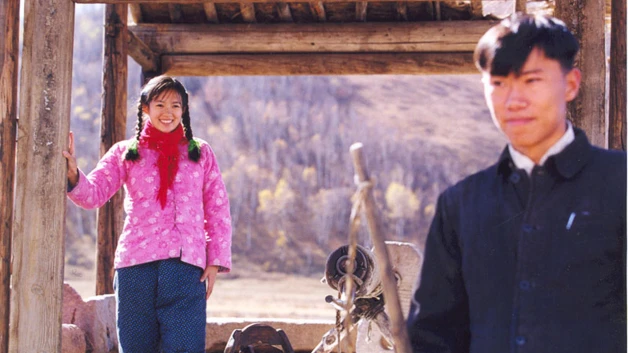
The Structure of Crystal Film Difficulty Ranking: 3

Be a fly on the wall as two old friends meet up after years have passed. The serene setting and conversation about the meaning of life will keep you feeling warm and calm like a mug of hot tea. Watch it here (Amazon via Mubi channel) and read more about it below.

Why watch The Structure of Crystal?
  • Experience life and it’s simple pleasures
  • Contemplate the meaning of life
  • Hear a beautiful soundtrack
  • If you’re a fan of early Ingmar Bergman (see Wild Strawberries for a perfect comparison – read more here)
The Breakdown

All we can see are two people standing on the distant horizon. They’re silhouetted against the pale sky and snow covered landscape. Their isolation is broken by a horse pulled sleigh which slowly makes it way past them. You can tell it’s going to be a slow and serene film; if that’s what you’re looking for you’re in for a treat.

The film takes place in rural Poland. The two people in the opening scene are Jan and his wife, both of them waiting for Jan’s old friend Marek to arrive. They studied Physics together at university but their paths have diverged since. Jan got married and moved to the remote countryside whilst Marek carried on studying physics and now travels the world with his degree.

The director perfectly captures the awkwardness of two old friends seeing each over for the first time in years. There’s lots of hugs and small talk, but neither of them really say anything to each other apart from how happy they each are to see each other. The feeling is perfectly captured when they all sit quietly at the dinner table not saying anything. The only thing you can hear is the clashing cutlery and the ticking clocks, emphasising that Marek’s stay is limited.

“I thought I had so much to tell you but now you’re hear I don’t know what to say”

Jan can’t break the small talk or silence, but Marek assures him their old friendship will resume. They eventually get round to talking about their past and their future. Both of them try to encourage the other to adopt their lifestyle.

Ticking Clocks and Ingmar Bergman

If you’re a fan of Ingmar Bergman, you might find some similarities between this film and Bergman’s Wild Strawberries (if you haven’t seen Wild Strawberries you need to watch it here on Amazon).

Both film’s have a similar contemplative feel and serene style. Furthermore, they both explore our search for meaning in life, which in both films becomes especially significant as the professor in Wild Strawberries feels himself getting closer to death, and in this film as the ticking clocks mark the short time Jan and Marek get with each other to catch up. Ultimately, they each reflect on their own choices and find peace with the path’s they have chosen.

Image result for structure of crystal film

Conclusion

I love contemplative and serene films, but I never feel like I can do them justice in writing. Like the early Ingmar Bergman films, The Structure of Crystal is all about the tone of the film. It’s a tone which somehow makes you calm and receptive but not sleepy. It’s just like listening to someone read you an interesting book when you’re tucked up in bed.

Watch The Structure of Crystal here (Amazon). And for more similar films, check out Ingmar Bergman’s Wild Strawberries and Seventh Seal.


Man Bites Dog Film Difficulty Ranking: 2

This may well be the darkest comedy there is. You may not agree at first, but you probably will by the end of the film. And you’ll probably feel like a murderer for watching it! This is one of the ultimate mockumentarys!

Why Watch Man Bites Dog?
  • If you like dark comedies – and when I say dark, I mean it!
  • If you like docu-fiction films (see Battle of Algiers or Che)
  • To learn how much ballast you need to sink a corpse
  • For a murderer’s ode to pigeons – actor Benoit Poelvoorde is crazy
The Breakdown

You’ll get an idea of what kind of a film this is from the opening. It starts with what looks like a normal scene. A man on a train is standing by the window as a woman walks past him along the corridor. However, as the man moves out of the way to let her pass, he rings a rope around her neck, forces her into a cabin and strangles her.

As you’ll quickly realise, this is not a serious film. However, you also won’t be surprised that it was highly controversial when it was released in 1992 (two years before Natural Born Killers).

Straight after the brutal opening scene, we meet Benoit (the murderer) again. This time, he is talking to the camera and telling us how to properly ballast a corpse so it sinks. Remember, ‘you need to ballast a dead body with 3 times it’s body-weight, and 5 times for old people as their bones are even more porous’ (Benoit’s quote, not mine).

The mockumentary style (mock documentary) makes the film even more real. Benoit looks straight at the camera a lot, and therefore straight at us. As a result, we are forced to get close to him and pushed towards identifying with him. The intimacy is stretched even further as we are introduced to his family and friends, who all say what an ‘affectionate and sweet’ person he is. But every time we start to get comfortable with him the director reminds us of his violence. For example, in one scene he starts playing with a few kids in a park making him appear normal, but the director quickly cuts to a montage of him murdering innocent people to remind us that he is a murderer.

Image result for man bites dog

Conclusion

Man Bites Dog is provocative. But it’s also clever. It plays with us throughout the film, encouraging us to get close to a murderer before brutally showing us images that are undeniably wrong and shocking. There’s also a pretty meta commentary on both the moral obligation of the film-makers and the audience. Are the film-makers and us morally wrong for making/watching this film?

Either way, for more, I’d recommend checking out Oliver Stone’s Natural Born Killers (with a young Woody Harrelson leading). Also check out Behind the Mask for a horror movie equivalent.


Sampha: Process Film Difficulty Ranking: 2

If you’ve been watching a lot of films recently, you’ll notice that Sampha: Process is different. Firstly it’s got a lot of music, which you’d probably expect as it’s an extended music video. Secondly, you’ll notice the quick and choreographed cuts (the editing works with the music). Music videos are where Spike Jonze and David Fincher started out, will Khalil Joseph transition to feature films as well?

Why Watch Sampha: Process?
  • Because there’s art in music videos – Director Khalil Joseph made a name for himself with this art/music video to accompany Kendrick Lamar’s Good Kid, M.A.A.D City and also directed Beyonce’s Lemonade visual album
  • If you like Sampha (you’ll at the very least appreciate his voice if you’re a music fan)
  • It will make you want to go to Freetown, Sierra Leone
  • For some fast cuts and symbolism – exactly what you’d expect from an extended music video
The Breakdown

First off, if you haven’t heard of Sampha, you should check out his latest Mercury Prize winning album Process before you watch this film – give it a listen here. Then you’ll need to know that this album was created after he lost his mum to cancer. He deals with loss in the music, but it is also the focus of this film.

Throughout the film, Khalil Joseph cuts to the image of Sampha’s mum trapped in a chrysalis. Her image appears between the beautiful beaches of Sierra Leone and urban London, connecting the two different cities. As a result, she is the link that connects Sampha to Sierra Leone. Her death, along with her mother’s old age (she’s the last of 14 siblings), threatens the  link.

Image result for sampha process kahlil joseph

Conclusion

Sampha: Process is a film you should watch if you want to see how to adapt a music album into a film. Khalil Joseph takes a brilliant, complete album and manages to add more depth to it.

For more, check out this art/music video Khalil Joseph made for Kendrick Lamar’s Good Kid, M.A.A.D City album.


Rey Film Difficulty Ranking: 4

If you love films about mad historical characters then check out Rey. It follows the unlikely story of Orelie-Antoine de Tounens, a French country lawyer who ventures to Chile in 1858 to unite the Mapuche. If you liked the madness of Aguirre or Apocalypse Now check this art-house flick now! I recommend watching the trailer below to see if you can handle it!

Why Watch Rey?
  • It took 7 years to make – director Niles Atallah even buried the 16mm film footage in his back garden to artificially age it
  • If you want a Quixotic version of the Herzogian madmen (see Aguirre or Apocalypse Now)
  • It stretches the boundaries of film by playing with myth, memory, and history
  • To feel like you’re in one of the world’s last wildernesses
The Breakdown

Rey begins with a Frenchmen who landed on the coast of Chile in 1858. According to legend he traveled to the end of the South American continent to create his own kingdom. He united the tribes from the region and proclaimed himself king.

If you think it already sounds mythic, the film’s experimental style makes it seem even more unbelievable. We first meet the self proclaimed king standing alone in the wilderness shrouded in mist. After the mist clears, he declares himself ‘the king of water’ as water magically flows from his hands into a pool of water below him.

The unusual images don’t stop there either. Later on, when he is on trial, all the characters involved in the trail are wearing paper-mache masks. The masks could signify the character’s lost connection with the true history of the continent (they refuse to acknowledge the tribes in the south). Or that they use the masks to hide their true history, which is ultimately wiped out.

Is Rey an allegory of colonialism?

As the French lawyer narrates how he came to South America, we are shown images of ships landing and western looking men riding horses. He describes how he ‘flew across the sea’ and immediately ‘felt the spirit of the land.’ Layering his narration over the images of westerners arriving is an allegory to the colonizers who came across the seas centuries before. He like them, has come to take control of the land. In his case, he ventures south in an attempt to unite and lead the Mapuche tribes. In doing so, he brings the last autonomous region in Chile into the spotlight. Ultimately, he is the tribes downfall.

Image result for rey niles atallah

Conclusion

Rey is one of the experimental films that works well. It pieces together the beginning of the end for the last autonomous tribes in Chile through the unbelievable character of Orelie-Antione de Tounens. It’s a creative depiction of a enigmatic character that fuses myth, memory, and history to tell an unlikely story.

For more similar (but easier to watch) films of enigmatic characters in Southern America, check out Aguirre and The Lost City of Z. Or if it’s a good jungle film you’re after, check out The Embrace of the Serpent and Apocalypse Now.

Anina Film Difficulty Ranking: 2

Do you miss the animations and story books you used to read as a kid? Anina will bring back your childhood with whimsical animation and a heart-warming story. If you have young ones or you’re young at heart, this one’s for you.

Why Watch Anina?
  • For anyone with kids, or your young at heart
  • To see it’s unique style which may remind you of a storybook
  • To hear the ‘worst names’ from Uruguay (Anina hates her name which is read the same forwards and backwards)
  • It’s here on YouTube (if you can understand Spanish)
The Breakdown

Anina starts at the end of a school day. Some parents are crowding round the entrance of the school waiting for their kids under their umbrellas. Some of the other kids are waiting at a bus stop nearby. It’s obvious who the protagonist is as she’s the only one with hair that stands out against the palette of grey, beige, and brown. Her hair is red and sticks out from her head. She’s Anina, our 10 year old protagonist.

You’ll notice the look of this animation is different to the Disney and Pixar films you’ve become used to. Firstly it’s 2D rather than the 3D used in most modern animation. Secondly, it’s uses a flat colour palette with no vibrant colours. As a result, Anina looks more like a children’s storybook rather than a vibrant Pixar film. This made it feel more whimsical and endearing.

One of my favourite stylistic moments occurs when she has a childhood memory. In the memory, the animation becomes even more basic than in the present: her facial expressions are less detailed and the background is plainer. It reflects the memories we all have, in which the detail is eroded by time.

Image result for anina

Conclusion

Like the best family films, Anina combines humour with a beautiful message about the family and friends. In addition, it’s unique animation evokes a nostalgia for children’s storybooks. If you’ve got young kids, or you still feel like a kid inside, Anina is worth a watch.

For more whimsical animation check out Song of the Sea by Tomm Moore. Also, no matter what age you are, watch Princess Mononoke by Hayao Miyazaki.